
Key Takeaways
- Writing improves fastest at the sentence level. Learn to spot weak verbs, vague wording, passive constructions, filler, and overload, then revise directly.
- Strong sentences share repeatable traits: one clear point, concrete wording, lean structure, visible action, and varied length that keeps reading smooth.
- Redundancies, clichés, fillers, abstract nouns, and the “and” trap weaken credibility.
- Consistent sentence checks during revision reduce word count, sharpen meaning, and make strong writing a repeatable process.
Improving writing doesn't come from memorizing countless rules, but rather from learning to recognize weak sentences and fixing them. You get better at writing by working at the sentence level: choosing active constructions, cutting filler, pulling real verbs to the surface, varying rhythm, and removing soft qualifiers. These small moves sharpen meaning and strengthen the flow of the text.
5 Characteristics of Strong Sentences for Better Writing
Good writing starts at the sentence level. Every writer who wants better results eventually learns to judge sentences correctly. Sentence-level work is important for all kinds of writing because it determines how credible and easy-to-follow your writing is. These are the common traits that most strong sentences share:
- Clear: The sentence carries one main point. The reader doesn’t need extra reading time to decode it.
- Specific: Concrete words replace vague phrases. You can see the idea, and you can argue with it.
- Concise: The sentence doesn't include unnecessary words that take up space without adding meaning.
- Direct: The subject acts, the verb describes concrete action.
- Natural: The sentence can be polished and precise while still sounding human.
One more detail that matters: rhythm. Sentences that follow the same pattern tire the reader. Any strong paragraph usually mixes long and short phrases because writers who vary sentence length keep attention.
Want to Improve Your Writing?

The Difference Between Good and Bad Sentences
Good and bad sentences differ in function, not style. A good sentence communicates one clear idea with minimal effort from the reader. A bad sentence delays meaning and scatters focus. This section breaks down those differences through concrete examples so you can apply the patterns to your own writing.
Example Sentences: Weak Verbs vs. Strong Verbs
Weak verbs spread a single action across several words. They often depend on vague phrases that delay the main point and reduce precision. Strong verbs state the action directly, which shortens the sentence and makes the meaning clearer. Replacing weak verbs with specific ones is a quick way to improve your academic writing.
Weak sentence: She gave a description of the problem during the meeting.
Revised sentence: She explained the problem during the meeting.
Example Sentences: Vague vs. Concrete
Vague language leaves meaning open-ended. It forces the reader to fill in gaps and guess what the writer intends. Concrete language grounds ideas with detail, which makes sentences easier to understand and remember. Precision also signals control, especially in academic and analytical contexts.
Weak sentence: The room felt uncomfortable.
Revised sentence: The room felt cramped, loud, and overly warm.
Example Sentences: Active vs. Passive Voice
Passive constructions often hide who is responsible for an action or push that information later in the sentence. Active constructions state who acted and what they did in a direct order. This makes the sentence easier to understand and reduces ambiguity, which is especially important in analysis, instructions, and any writing that assigns responsibility.
Weak sentence: The mistake was noticed late in the process.
Revised sentence: The team noticed the mistake late in the process.
Example Sentences: Awkward vs. Smooth Flow
Awkward flow usually comes from structural problems. Too many ideas get packed into one sentence, or clauses pile up without a clear order. The reader has to sort things out themselves. When ideas are separated and arranged logically, the sentence reads more easily. In most cases, splitting a sentence or rearranging its parts solves the issue.
Weak sentence: Learning to write well takes time and effort, and people also need patience, and they often have to read more, and practice regularly, and stay motivated even when progress feels slow.
Revised sentence: Learning to write well takes time, effort, and patience.
Pro Techniques to Get Better at Writing
Progress improves when you stop collecting advice and start applying a small set of repeatable checks. Learning to write better depends on clarity, word economy, verb choice, and sentence structure. The writing techniques below target those areas directly.
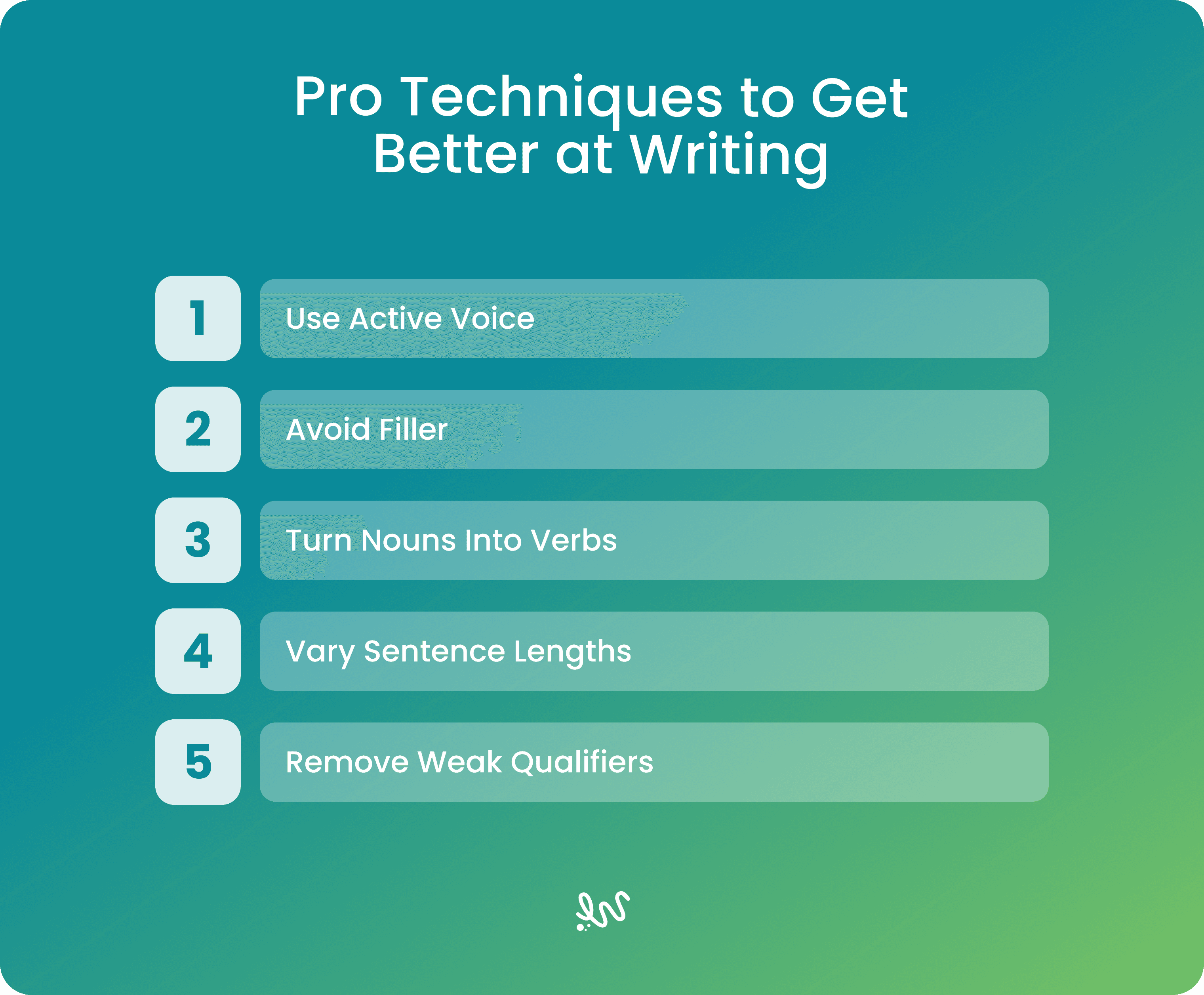
1. Use Active Voice
Active voice places the subject in control of the action. The structure is: Subject - Verb - Object
When the subject appears late or disappears, the reader must take a moment to reconstruct who acted. Passive voice often causes this delay by pushing the subject into a prepositional phrase or removing it entirely. That delay makes writing feel heavy and evasive, even when the content is straightforward.
Active voice reduces word count because it removes helper verbs and excess phrasing. It also increases sentence speed by letting the action appear earlier. Readers understand the sentence faster because the responsibility is clear.
Passive: The final recommendation was approved by the board after review.
Active: The board approved the final recommendation after review.
2. Avoid Filler for Word Count
Filler phrases inflate sentences without adding anything concrete. They often appear during drafting when the writer hesitates or tries to sound formal. Over time, they weaken authority because they delay the core idea and soften the statement.
When you remove filler, the main idea appears earlier in the sentence. The reader understands the claim faster because fewer words delay it. That makes the sentence clearer and more direct, especially in academic or instructional writing.
- In order to
- Due to the fact that
- It is important to note that
- At this point in time
- In the event that
- For the purpose of
- In a manner that
- There is a possibility that
Wordy: In order to improve accuracy, the team reviewed the data twice.
Tighter: To improve accuracy, the team reviewed the data twice.
The meaning stays intact, but the second sentence sounds firmer because the idea appears sooner.
3. Turn Abstract Nouns Back Into Verbs
Many sentences slow down when verbs are replaced with abstract nouns. This pattern appears often in words ending in -tion, -ment, -ance, or -ity. Once a verb becomes a noun, the sentence needs extra supporting words to explain what happened. Length increases and, as a result, clarity drops.
Words such as implementation, explanation, improvement, evaluation, and assistance frequently appear with weak verbs like make, provide, or conduct. Together, they stretch one action across several words instead of stating it directly.
To revise, locate the noun that signals an action. Then recover the verb it represents and rewrite the sentence using that verb. This will result in shorter, clearer, and easier-to-read sentences without changing the meaning. Besides, it's an excellent way to expand your vocabulary.
Before: The supervisor conducted an evaluation of employee performance.
After: The supervisor evaluated employee performance.
The revision removes unnecessary structure and places the action where the reader expects it.
4. Vary Sentence Length
When every sentence in a paragraph follows the same length and structure, the writing starts to feel mechanical. The issue is not long sentences or short sentences, but the repetition of any kind. To fix this, review a paragraph and look for uniformity. If sentences cluster around the same length, adjust the pattern. Break one sentence into two, or combine a pair that share a single idea. Keep meaning intact while changing structure. This variation keeps ideas distinct and prevents reader fatigue. Take a look at the paragraph example below, where the meaning stays the same, but the rhythm keeps the reader engaged:
I write every day to improve my writing skills.
I revise each draft using the same approach.
I check grammar and spelling carefully.
I submit the work when it feels complete.
I write every day.
Over time, consistent revision strengthens my writing.
Grammar and spelling receive careful attention.
When the work feels complete, I submit it.
5. Remove Weak Qualifiers
Weak qualifiers soften statements without adding information. Words such as very, really, basically, perhaps, and I think signal uncertainty instead of nuance. Readers interpret that hesitation as a lack of authority. When these words disappear, the sentence must rely on its content. If the claim holds, it reads stronger. If it doesn’t, the weakness becomes visible and easier to fix.
Weaker: I think the results are very important for the study.
Stronger: The results are important for the study.
These writing techniques can help you improve your writing skills. Read them carefully if you're searching, 'How to do my essay without AI.'
What Weakens Writing at a Sentence Level
Most sentence-level problems come from routine habits. Writers rely on familiar patterns and stop questioning them. Length increases. Meaning softens. Reading slows. These issues show up across academic, professional, and creative writing, usually without intent. Revision works when you know what to look for.
Common weaknesses include:
- Redundancies, such as return back or end result, which add length without adding meaning.
- Clichés, which replace precise language with phrases readers recognize instantly and ignore just as fast
- The “and” trap, where unrelated ideas are joined, forcing one sentence to carry more than it should
- Overloaded sentences, where multiple claims compete and weaken the main point
- Unclear references, where pronouns lack a specific noun and confuse the reader
- Excess modifiers, which slow pacing and reduce focus without improving clarity
Make Every Sentence Stronger
Final Thoughts on Becoming a Better Writer
Becoming a better writer depends on sentence awareness, not stylistic tricks. Good writing comes from clear subjects, active verbs, precise wording, controlled length, and direct structure. Weak sentences usually fail for repeatable reasons, and those reasons can be fixed. When you revise with intention, clarity improves, word count drops, and flow becomes easier to manage. Over time, these checks turn into a habit and make improvement consistent rather than accidental.
And remember, if your approaching deadlines keep you thinking, 'I wish someone could complete my college essay for me', our professionals are always ready to give you a helping hand!
FAQ
How Can I Improve Sentence Flow in My Writing?
Check sentence length and structure within a paragraph. If several sentences share the same length or pattern, revise one by splitting it and combine two others. Flow improves when sentences do not repeat the same rhythm.
What Is the Simplest Way to Cut Word Count?
Remove filler phrases, weak qualifiers, and noun-based constructions. Replace abstract nouns with verbs. Most word count drops come from rewriting sentences, not deleting content.
Is It Acceptable to Begin a Sentence With And, But, or Because?
Yes. Use these words when they connect directly to the previous sentence. Avoid them when they introduce a new idea that should stand alone.
How Can I Tell When a Sentence Is Too Long?
A sentence is too long when it carries more than one main idea. If you can split it into two sentences without losing meaning, it is too long.
How Does Vague Writing Differ From General Writing?
General writing uses broad terms on purpose. Vague writing uses broad terms because the writer has not specified what they mean.
Sources
- Building habits to be a better writer: read daily | Writing and Communication Centre. (2024, May 21). https://uwaterloo.ca/writing-and-communication-centre/blog/building-habits-be-better-writer-read-daily
- Carini, A. (2002). Nine Basic Ways to Improve Your Style in Academic Writing | Student Learning Center. https://slc.berkeley.edu/writing-worksheets-and-other-writing-resources/nine-basic-ways-improve-your-style-academic-writing
- One month of writing improvement. (n.d.). https://www.ctl.ox.ac.uk/rewrilab/one-month-of-writing-improvement