TOK essay examples are model responses that show how IB students approach prescribed titles with clear reasoning, balanced arguments, and careful use of knowledge. Strong examples of TOK essay work illustrate how real-life examples connect with theory, how key terms are defined, and how claims and counterclaims stay grounded in specific Areas of Knowledge. You’ll often see prompts like ‘Is subjectivity overly celebrated in the arts but unfairly condemned in history?’ or ‘Do we need custodians of knowledge?’ used to compare the arts, history, or natural sciences.
If you’ve been searching for ‘native writers for my essay’ who know how TOK essays are evaluated, WriteMyEssay connects you with the right experts.
Need Help Writing Your TOK Essay?

What Is a TOK Essay?
A TOK essay is a core assessment in the International Baccalaureate that asks students to examine how knowledge is created, justified, and challenged. Its purpose is to evaluate how well a student can analyze prescribed essay titles, develop knowledge questions, and explore different areas of knowledge through reasoned arguments and real-life examples.
TOK Essay Structure Explained
A strong TOK essay has a shape that keeps ideas moving with purpose. Instead of jumping between points, it builds from a focused opening, into body paragraphs that test ideas across two Areas of Knowledge, and finishes by stepping back to reflect on what the analysis really shows. This structure helps maintain a clear line of inquiry and prevents the essay from drifting into description. Different Areas of Knowledge classify information using distinct criteria, which affects what is accepted as valid knowledge.
Opening the TOK Essay: Introduction and Thesis
The introduction is where you set the direction of your thinking. It signals how you interpret the prescribed title and shows that your approach is deliberate rather than improvised.
In this section, you should:
- Address the prescribed title directly and explain how you understand what it is really asking.
- Pin down any key terms that could change the meaning of the question if they stay vague.
- Make your overall position clear so the reader knows the direction your argument will take.
- Indicate the two Areas of Knowledge you’ll use to examine the issue.
- Hint at how your analysis will develop, without turning the introduction into a roadmap.
A typical TOK essay introduction example is about 150–200 words long. That length gives you enough room to establish direction and intent, without crowding out the deeper analysis that belongs in the body of the essay.
Example: Disagreement between experts is often treated as a sign of uncertainty, yet it can also indicate active knowledge development. When informed perspectives conflict, assumptions are tested and methods refined. This essay examines whether expert disagreement strengthens knowledge, focusing on the natural sciences and the human sciences.
Developing Ideas: Body Paragraphs
The body of the essay is where TOK thinking becomes visible. Each Area of Knowledge is usually explored through one or two paragraphs that move between claims, counterclaims, and evaluation.
Within each body section, aim to:
- Introduce a knowledge claim that responds directly to the prescribed title.
- Ground that claim in a specific real-life example from the chosen AOK.
- Consider a counterclaim that challenges or complicates your initial position.
- Support that counterclaim with another well-chosen real-life example.
- Analyze how these perspectives connect back to the title and your overall stance.
Body paragraphs are typically 250–350 words long. They should feel analytical rather than narrative, with examples used to support thinking, not replace it.
Example: In the natural sciences, disagreement between experts often plays a constructive role in strengthening knowledge. Competing interpretations of data force scientists to refine methods, improve measurement, and test assumptions more rigorously. For example, debates over climate modeling have led to more precise data collection and transparent statistical methods. Rather than weakening trust, such disagreement narrows uncertainty and increases confidence in conclusions that survive sustained scrutiny.
Drawing Meaning Together: Conclusion
The conclusion brings the essay to a close by pulling together insights rather than repeating earlier points. Its focus is reflection and synthesis.
In this final section, you should:
- Revisit the main ideas developed across both Areas of Knowledge.
- Give a clear final answer to the prescribed title, with the same balanced tone you used in the body.
- Point out where your reasoning has limits, for example, where the conclusion depends on context, the type of evidence, or the Area of Knowledge.
- Zoom out for a moment and say what your analysis suggests about how knowledge gets built, trusted, or challenged in the real world.
- End with a line that shows the investigation led somewhere meaningful, even if the title still has room for debate.
Example: Disagreement between experts does not automatically weaken knowledge. When grounded in evidence and shared standards, it exposes limitations, sharpens reasoning, and drives progress. While disagreement can create temporary uncertainty, it ultimately strengthens knowledge by refining methods and deepening understanding, especially in areas where absolute certainty is neither possible nor expected.
5 TOK Essay Examples
This section brings together five TOK essays, carefully selected by our college essay writers to illustrate strong analysis. If you prefer to study offline, TOK essay examples PDF are available free for download.
TOK Essay Example 1
This TOK essay example explores how language influences what is accepted as knowledge by comparing the natural sciences and history. It shows how terminology, interpretation, and narrative shape credibility, meaning, and understanding in different Areas of Knowledge.
TOK Essay Example 2
This TOK essay examines whether models and theories help us reach truth or distance us from reality by comparing their use in the natural sciences and economics, focusing on usefulness, limits, and revision.
TOK Essay Example 3
This TOK essay examines how disagreement between experts can strengthen knowledge rather than weaken it, using examples from the natural sciences and history. For closer study, it is included in our PDF TOK essay examples, available free for review and practice.
TOK Essay Example 4
This TOK essay sample explores whether personal experiences offer a deeper understanding than shared knowledge by comparing the human sciences and the natural sciences. It shows how individual perspectives can enrich insight, while shared knowledge provides reliability and wider applicability.
TOK Essay Example 5
This example of a TOK essay examines how historical context shapes what is accepted as knowledge by comparing history and the natural sciences, showing how interpretation, evidence, and changing perspectives influence credibility over time.
For comparison with structured argumentation, you can also review an argumentative essay example.
Tips for Writing a TOK Essay
The following tips focus on how to turn your ideas into a clear, well-reasoned TOK essay that stays focused on the prescribed title.
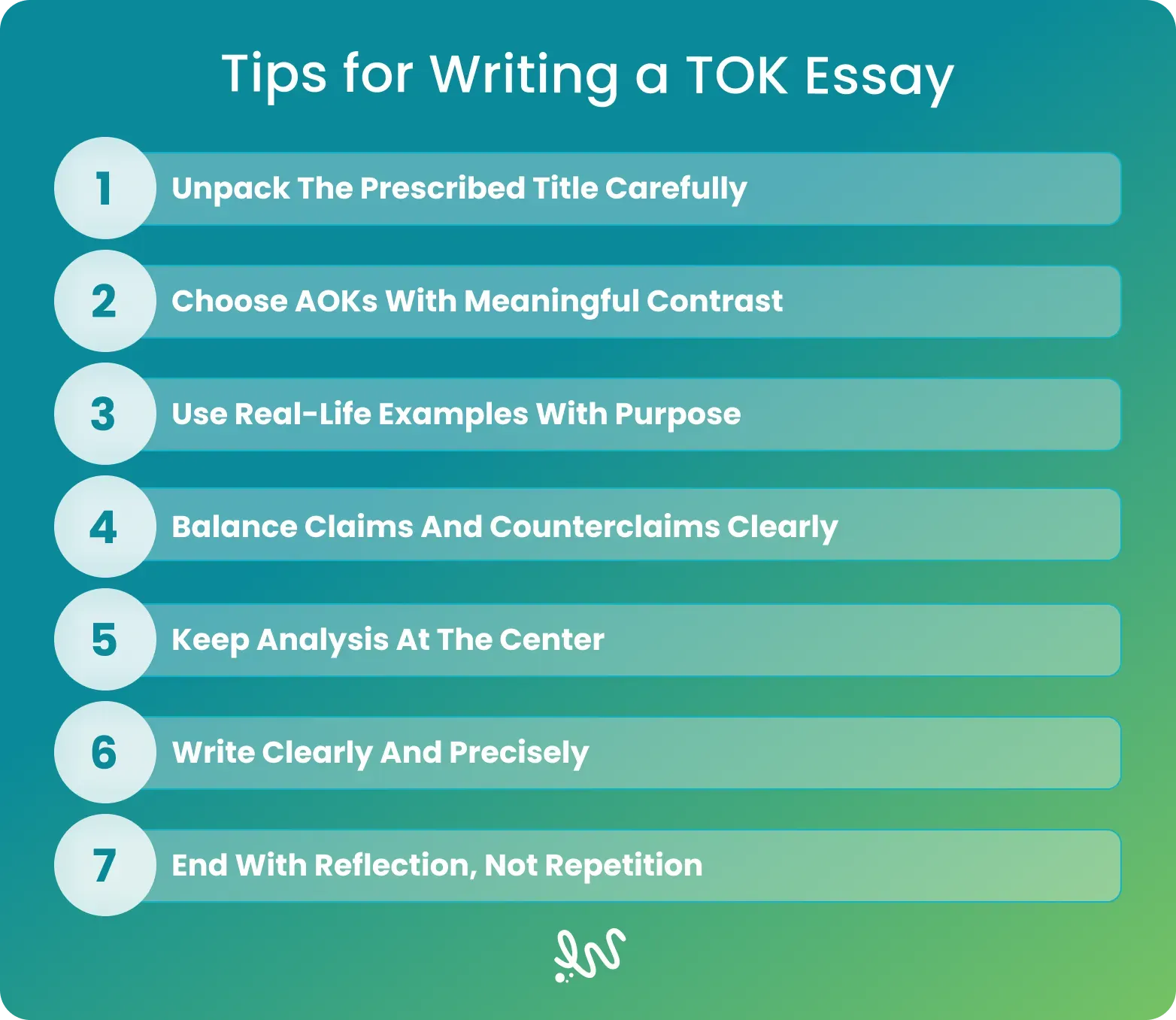
- Start by unpacking the prescribed title carefully. Before writing, spend time clarifying key terms and deciding what the question is really asking. Reading a strong sample of TOK essay can help you see how focused interpretations are developed early.
- Choose Areas of Knowledge that allow meaningful comparison. Pick AOKs where the question creates tension or contrast, rather than forcing similarities that are hard to justify.
- Use real-life examples with purpose. Each example should directly support a claim or counterclaim, not sit in the paragraph as background information.
- Balance claims and counterclaims within each AOK. TOK essays reward measured evaluation, so show how different perspectives complicate the issue rather than pushing one-sided arguments.
- Keep analysis at the center. Describe examples briefly, then spend more time explaining what they reveal about knowledge, justification, or interpretation.
- Write with clarity rather than decoration. Precise language and careful explanation matter more than complex phrasing.
- End with reflection. A strong conclusion revisits the question and highlights implications or limits without restating earlier paragraphs.
How to Find Examples for TOK Essay
Strong TOK essay examples come from studying how good thinking is constructed, not copying finished answers. Official IB materials, such as past prescribed titles and examiner reports, show what earns marks and how arguments are evaluated. Academic writing blogs and study platforms also offer guided examples that explain structure and analysis. Some students use WriteMyEssay to review TOK-style examples written by experienced writers, which helps clarify tone and depth. Beyond essays, news articles, historical cases, and scientific debates can all become TOK examples when clearly linked to Areas of Knowledge and the title.
TOK Essays Done With Expert Support
Quick Recap
Writing a strong TOK essay comes down to clear interpretation, balanced arguments, and purposeful examples. The TOK essay samples provided in the article showed how prescribed titles are unpacked, Areas of Knowledge are compared, and claims remain tied to real-life situations rather than drifting into theory.
If you’re struggling to put everything together or feel stuck at the drafting stage, WriteMyEssay can help. Our writers support students who need guidance with structure, argument flow, or tight deadlines. If your challenge is more specific, such as legal writing, you can also get help with law essay writing.
FAQ
How to Find TOK Essay Examples?
TOK essay examples can be found in IB-released materials such as past prescribed titles, examiner reports, and student samples. Academic writing blogs and study platforms like WriteMyEssay also publish analyzed examples that explain structure and evaluation. These sources help you see how ideas are developed and linked to Areas of Knowledge.
What Qualities Make a TOK Essay Example Effective?
An effective IB TOK essay example shows clear engagement with the prescribed title, balanced claims and counterclaims, and well-chosen real world examples. It keeps analysis at the center, uses precise language, and maintains a clear line of inquiry from introduction to conclusion.
Is It Acceptable to Use Examples From Sample TOK Essays in My Own Work?
You should not reuse examples directly. Sample essays are meant to show how to think, not what to write. Use them to understand structure and reasoning, then apply those techniques to your own original examples and ideas.
Which Examination Sessions Provide the Most Useful TOK Essay Examples?
The most useful examples are from recent examination sessions, as they reflect current assessment criteria and expectations. Older examples can still be helpful for structure, but newer ones align more closely with how TOK essays are currently marked.
Sources
- IB Mid-Atlantic. (n.d.). Sample TOK essays. https://ibmidatlantic.org/TOK10/Sample_Essays.pdf
- The TOK Resource. (n.d.). Theory of Knowledge resources. https://www.tokresource.org/
- International School of Zug and Luzern Library. (n.d.). Theory of Knowledge guide. https://iszl.libguides.com/c.php?g=705649&p=5254036