
Shorten an essay by tightening prose, merging overlapping paragraphs, and cutting language that adds length without adding meaning. For example, phrases like, “in order to,” “due to the fact that,” “it is important to note” take up space without adding meaning. If you’re wondering how to make an essay shorter, the answer is disciplined revision. This article walks you through 14 practical steps with examples so you can reduce word count while protecting clarity, logic, and argument strength.
1. Remove Paragraphs That Add No Value
Some paragraphs feel useful, but once you look closely, they repeat earlier ideas or drift away from the prompt. When you reread with a critical eye, ask: Does this section push the argument forward? If not, delete it completely.
Original: Many students face various academic challenges in modern education. These challenges influence outcomes in multiple ways and shape overall performance across subjects.
Revised: Academic challenges influence student performance across subjects.
Too Many Words, Too Little Time?

2. Cut Distracting Descriptions
Writers often include interesting context that does not really support the thesis. Let's say you're writing an informative essay. If you drift into description, it might sound intelligent, yet it will weaken the focus of your paper by distracting the reader. Reducing word count in an essay requires removing information that does not directly strengthen your main claim.
Original: Social media affects concentration. Communication platforms have developed over decades, evolving through messaging systems and online forums before reaching current formats.
Revised: Social media reduces student concentration.
3. Erase Extra "The" and "That"
Small function words build up across a draft and inflate the word count. Articles and connectors often serve a grammatical function, yet many fail to strengthen clarity. Strategic trimming removes excess while preserving meaning and structure.
Original: The clarity of your argument depends on the strength of the evidence that you present in the essay.
Revised: Your argument’s clarity depends on the strength of your evidence.
4. Condense Quotations
Long quotations inflate your page quickly. To fix this, use only the essential fragment or summarize the idea in your own language. Cutting down essay word count often begins with tightening quoted material.
Original: The author writes, “Education plays a critical and essential role in shaping the overall development of individuals within society.”
Revised: The author argues that education shapes individual development in society.
5. Use Active Voice
Passive voice stretches structure and hides responsibility. Active voice, on the other hand, shortens sentences and strengthens impact. A direct subject and verb combination helps you avoid using unnecessary words.
Original: The experiment was conducted by the research team during the final stage of the study.
Revised: The research team conducted the experiment during the final stage.
6. Cut Filler Phrases
Filler phrases make writing longer without making it clearer. Expressions like “in my opinion” or “due to the fact that” take up space and weaken the sentence. Cut them to shorten an essay effectively. Your argument becomes tighter, more direct, and easier to read.
Original: In my opinion, the policy is ineffective due to the fact that it lacks sufficient funding and resources.
Revised: The policy is ineffective because it lacks sufficient funding and resources.
If removing filler phrases is too time-consuming, and you ask,
7. Reduce Word Count by Cutting Redundancy
Redundancy happens when two words deliver the same meaning, for example, final outcome. You think you’re adding emphasis, yet you’re only adding extra words. Remove the duplicate and keep the stronger term. This is one of the most practical ways to shorten an essay without changing your argument.
Original: The community experienced a terrible tragedy that caused deep sorrow and sadness among local residents.
Revised: The community experienced a tragedy that caused deep sorrow among residents.
8. Trim Unnecessary Adverbs and Adjectives
Too many adjectives and adverbs water down your point. If a modifier does not introduce measurable detail, remove it. Specific language carries more force than stacked intensifiers. Tight sentences improve clarity and reduce bulk at the same time.
Original: The extremely important and very significant decision had a truly massive impact on the overall results.
Revised: The decision changed the results significantly.
9. Simplify Verb Constructions
Long verb phrases often hide a simple action. Replacing multi-word constructions with one precise verb is a simple way to make essay shorter without sacrificing meaning or depth.
Original: The committee conducted an investigation into the matter and made a decision regarding future policy changes.
Revised: The committee investigated the matter and decided on future policy changes.
10. Prioritize Shorter Words
Lengthy vocabulary increases word count without increasing clarity. Use shorter words when you can do it without compromising meaning. Direct language strengthens academic writing and keeps your sentences efficient.
Original: The implementation of the initiative facilitated the improvement of organizational productivity across departments.
Revised: The plan improved productivity across departments.
11. Combine Paragraphs
Two paragraphs that make the same point weaken the structure and unnecessarily increase the length. Instead, merge them into one focused section that presents the idea once, clearly and completely.
Original: One paragraph explains that student stress affects academic performance. Another paragraph repeats that pressure reduces concentration and harms results.
Revised: Student stress affects academic performance by reducing concentration and harming results.
12. Eliminate Unnecessary Transitions
Many drafts lean on long transition setups that explain what is already clear. Phrases such as “it is important to note that” or “it should be mentioned that” delay the real point. Using direct statements is one of the most practical tips to shorten essay length.
Original: It is important to note that, in addition to the argument discussed earlier, student motivation also plays a significant role in academic performance.
Revised: Student motivation also plays a significant role in academic performance.
13. Reduce Overused Conjunctions
Conjunctions help connect ideas, yet excessive linking stretches sentences. If several parts make the same point, tighten the structure. Cut repeated connectors and combine related thoughts into one clear, direct sentence.
Original: Students feel pressure because deadlines approach, and they have multiple assignments, and they worry about their grades.
Revised: Students feel pressure as deadlines approach, assignments accumulate, and grade concerns increase.
14. Rewrite Expletive Openings
Sentences that begin with “there is,” “there are,” or “it is” often bury the subject. Move the real actor to the front. Cutting words from an essay frequently starts with tightening these openings.
Original: There are several factors that contribute to student stress during the academic semester.
Revised: Several factors contribute to student stress during the academic semester.
Efficient Editing Techniques for Academic Writing
Editing is a methodical process. You tighten structure, examine purpose, and remove excess with intention. These techniques keep revision focused and practical:
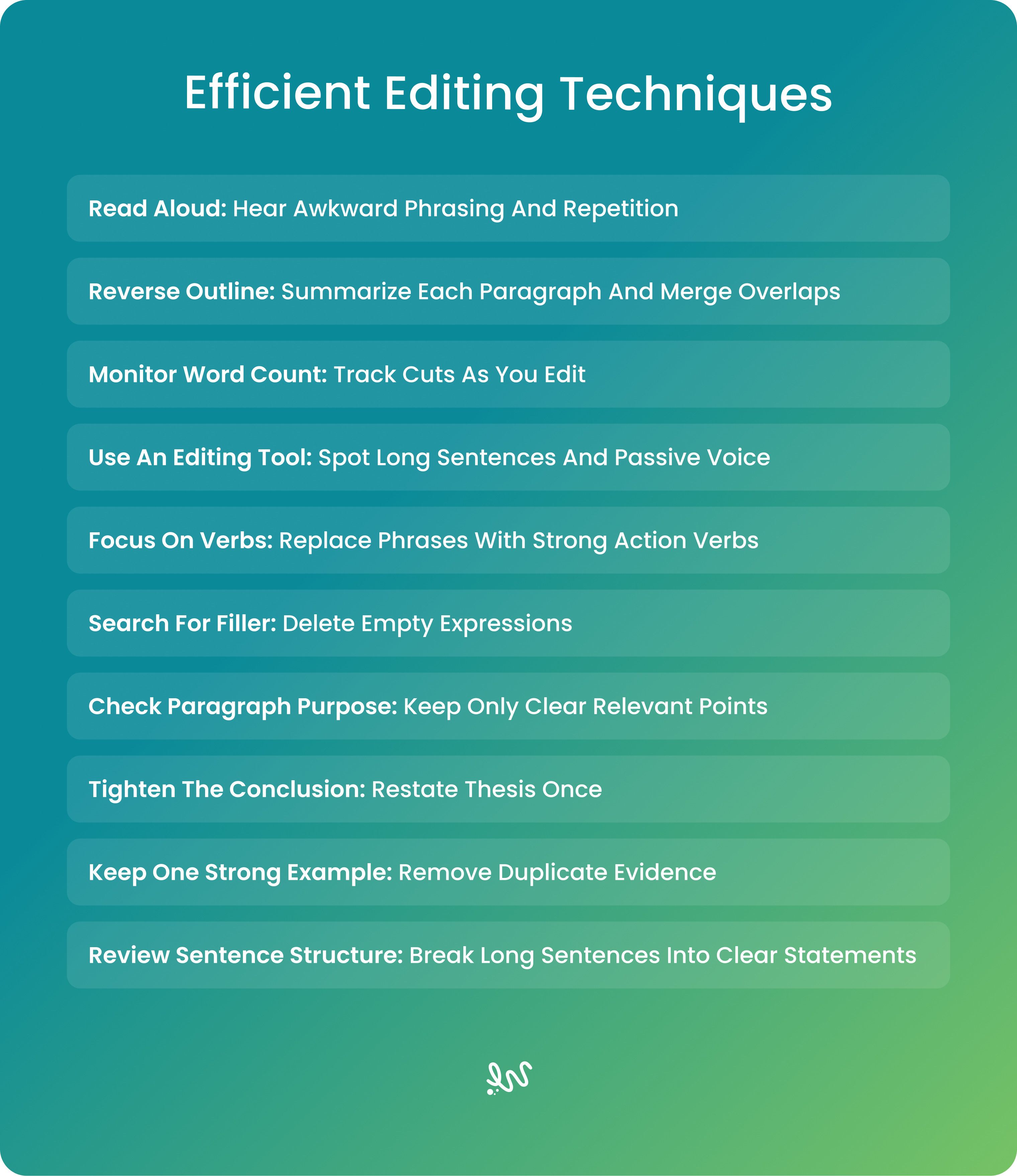
- Read Aloud: Your ear catches what your eyes skip. Awkward phrasing, long-winded sentences, and repeated ideas become obvious once you hear them.
- Reverse Outline: After finishing the draft, write one clear sentence that captures each paragraph’s point. If two summaries say the same thing, combine them. If one drifts from the thesis, revise or remove it.
- Monitor Word Count: Check your maximum word count as you edit. Cutting ten words in five places reduces bulk without harming substance.
- Use an Editing Tool: A word count tool or AI editor highlights long sentences and passive constructions. Let the tool point things out, then make the final decision yourself.
- Focus on Verbs: Strong verbs shrink sentences. Replace multi-word constructions with precise action verbs.
- Search for Filler: Use “Ctrl+F / Cmd+F” to locate phrases such as “in my opinion” or “it is important to note.” Remove them unless they serve a specific function.
- Check Paragraph Purpose: Ask what each paragraph contributes. If the answer feels vague, the paragraph needs revision.
- Tighten the Conclusion: Restate your central idea once. Avoid replaying every example.
- Keep One Strong Example: If two examples prove the same point, keep the clearer one.
- Review Sentence Structure: Break long chains into direct statements. Clear sentences reduce strain on the reader.
Quick Checklist
If you want to know how to write an essay fast and still stay within the limit, run through this list before submission:
- I removed paragraphs that repeat earlier points.
- I cut tangents that distract from my main claim.
- I deleted redundant phrases.
- I simplified long verb constructions.
- I revised passive voice into active voice.
- I trimmed unnecessary adjectives and adverbs.
- I shortened or summarized long quotations.
- I rewrote expletive openings like “there are.”
- I confirmed that each paragraph supports my thesis.
- I checked that my word count meets the required limit.
Tired and Out of Time?
Final Thoughts
Shortening an essay is about discipline, not just deletion. To reduce the word count, start by removing padding and tangents. Then, tighten sentences, trim modifiers, simplify verb phrases, and fix passive constructions. Merge overlapping paragraphs to cut repetition. Every change should protect your main argument while reducing word count and improving clarity.
FAQ
How to Quickly Shorten an Essay?
The best way to shorten essay drafts fast is to target big cuts first. Remove redundant paragraphs, trim long quotes, and replace wordy phrases with direct ones. Then scan for filler and passive constructions. Track your word count as you revise so you see progress immediately.
How Can I Reduce Word Count Without Losing Meaning?
Keep your ideas. Tighten the language around them. Swap long verb phrases for precise verbs. Remove weak modifiers. Merge overlapping examples. After each edit, check that the thesis still stands clearly. Precision preserves meaning better than random deletion ever will.
What Should I Remove First When Shortening an Essay?
Start with padding. Cut tangents that drift from the prompt. Delete repeated explanations and paired synonyms. Shorten introductions and conclusions that restate the same claim. Structural trimming reduces bulk faster than adjusting single words.
Is It Better to Edit Paragraphs or Sentences When Shortening?
Begin with paragraphs. Large structural changes save more space. Combine overlapping sections. Once structure is tight, revise sentences for clarity and concision. Order matters here. Fix the frame first, then polish the details.
What Common Mistakes Do Students Make When Cutting Word Count?
Students often delete evidence instead of trimming explanations. Some cut sentences randomly and damage coherence. Others rely only on word-level edits and ignore repetition. Effective revision protects the argument while removing excess language with intention.
Sources
- LibGuides: Editing and Proofreading: Reducing word count. (2025). https://www.shu.ac.uk/. https://libguides.shu.ac.uk/editing/word-count
- Working out what to cut - Swansea University. (2025). https://www.swansea.ac.uk/. https://www.swansea.ac.uk/academic-success/academic-skills-lab/academic_writing_articles/word-count/what-to-cut/
- Wolfson College Cambridge. (2020). Reducing your word count. https://www.wolfson.cam.ac.uk/sites/default/files/2020-05/ww_reducing_your_word_count_may2020.pdf