An argumentative essay example shows how a clear claim is built using logic and evidence. In many cases, these essays focus on debates that students already encounter, such as social media’s influence on relationships or public smoking policies tied to health. A strong structure is usually anchored by a focused thesis statement. Body paragraphs are developed with research and real examples, while opposing views are addressed through careful rebuttal.
At WriteMyEssay, we recognize how difficult this balance can be during the writing process. That is why we offer direct support through our argumentative essay writing service to keep arguments clear and persuasive.
When You Need the Essay Done Right

Argumentative Essay Examples for Students
Below, 5 good argumentative essay examples demonstrate how students can organize ideas and present arguments that hold up under scrutiny.
Argumentative Essay Example 1: Do Video Games Contribute to Increased Aggression in Children?
This essay argues how video games contribute to increased aggression in children. This question continues to surface in research discussions and family conversations alike.
What this essay does well:
- The argument develops gradually, allowing context and research to shape the central claim.
- Short-term emotional reactions are clearly separated from long-term behavioral conclusions.
- Research findings are presented with caution, avoiding exaggerated cause-and-effect claims.
- Age, environment, and supervision are treated as key variables rather than side notes.
- Counterarguments are addressed directly without dismissing opposing concerns.
Research suggests that some video games can influence aggressive behavior in the short term. Fast-paced games or those centered on violence often leave children emotionally charged right after playing. In that state, patience tends to wear thin. Small frustrations feel bigger than they normally would, especially for children still learning how to manage their reactions. The effect usually fades with time, though repeated exposure can make these responses more familiar and easier to trigger.
Current research does not suggest that video games directly cause long-term aggression. Most studies point to situational responses rather than lasting personality changes. When exposure occurs frequently and without guidance, emotional responses may become more habitual. This nuance is often lost in public debate.
The developmental stage further shapes how gaming content is interpreted. Younger children may struggle to distinguish fictional actions from acceptable real-world behavior. When negative consequences are absent or minimized, harmful actions can appear justified. Older children generally recognize the difference more clearly, though repeated exposure can still influence expectations about conflict resolution.
Beyond age-related factors, family relationships, peer interactions, and external stress strongly affect behavior. In many cases, gaming serves as an outlet rather than a primary source of aggression. Games can amplify existing tension, though they rarely generate it independently. Focusing solely on the media ignores these surrounding factors.
It is equally important to recognize that not all video games encourage aggressive responses. Many titles promote cooperation, strategic thinking, or problem solving. Team-based formats require communication and shared goals, while strategy-driven games reward planning and restraint. When such content is selected intentionally, behavioral outcomes can differ significantly.
Adult involvement remains a critical factor. Time limits reduce overstimulation, while discussion supports reflection. When children are encouraged to talk about what they play, content is processed more actively. Oversight shapes interpretation far more effectively than restriction alone.
In the long term, increased aggression appears under specific conditions. High exposure to violent content combined with limited supervision raises risk. That risk diminishes when structure and communication are present. Video games function as one influence among many, shaped by developmental stage and environment. Understanding this balance allows for informed responses rather than simplified conclusions.
Argumentative Essay Example 2: Do Influencers Carry Responsibility for Their Audience’s Behavior?
This essay examines the connection between online influence and audience behavior, focusing on how visibility, trust, and platform dynamics shape responsibility for influencers.
What this essay does well:
- Audience psychology is explained using research rather than assumptions.
- Responsibility is treated as nuanced rather than absolute or one-sided.
- Platform algorithms are included, which broadens the scope of the argument.
- Positive examples of influence add balance and realism to the discussion.
Influencers play a visible role in shaping online culture. Millions of people follow their daily routines, opinions, and recommendations. With that reach comes influence over attitudes and choices. The question is whether that influence creates responsibility for how audiences behave afterward.
Social media influencers often present themselves as relatable figures rather than authority figures, and their appeal lies in that sense of familiarity. Viewers feel as though they know them personally, which can increase trust, especially among younger audiences. When advice or opinions are shared in that context, they may carry more weight than traditional advertising or public messaging.
Research on social learning helps explain this effect. People, especially children and teenagers, tend to model behavior they see rewarded. Likes, sponsorships, and praise signal approval. When risky behavior, harmful language, or unhealthy habits receive positive attention, imitation becomes more likely. That influence does not guarantee action, but it lowers resistance.
Influencers do not control individual choices, and audiences remain capable of independent judgment. Still, content is not neutral. Promoting extreme dieting, reckless challenges, or misinformation can shape norms over time. Even without direct instruction, repeated exposure sends a message about what is acceptable. In that sense, behavior is influenced indirectly.
At the same time, responsibility cannot rest solely on creators because platforms amplify content through algorithms designed to reward engagement. Sensational material spreads faster than cautious messaging, and influencers operate within that system. Their choices are shaped by visibility pressures and financial incentives, which complicates blame when attention itself drives success.
Audience diversity also matters because not every follower reacts the same way. Adults often separate entertainment from guidance, while younger viewers may struggle more, as children and teenagers are still forming judgment and identity. For them, online figures can resemble role models, which strengthens the case for responsibility when large youth audiences are involved.
Positive influence is familiar, too. You have seen creators pause a video to talk honestly about burnout, or redirect attention toward a fundraiser that spreads faster than any ad campaign. These moments linger because they feel unplanned. A disclaimer flashed on screen, a sentence framed with care, or a choice to slow the tone when outrage would travel faster can all shape audience response. Influence remains present in those small decisions, shifting in subtle ways and hinting at what these platforms could become if more creators leaned into that quieter form of power.
Regulation remains limited, with few clear standards defining influencer accountability. Some argue that stricter rules could threaten creativity or free expression, while others point to real public harm when misinformation spreads unchecked. As a result, many propose a middle ground that emphasizes ethical responsibility rather than strict legal liability.
In the long run, influencers carry responsibility for how their content shapes audience behavior, even though that responsibility has limits. They influence attention and help normalize actions, especially among younger viewers. While they do not control individual choices, their decisions still matter. Responsibility is shared between creators, platforms, and audiences, and recognizing that balance encourages more thoughtful content.
Argumentative Essay Example 3: Should Governments Restrict Junk Food Advertising Aimed at Kids?
This essay discusses how junk food advertising targets children, why young audiences are more vulnerable to it, and where responsibility should sit between governments, parents, and companies.
What this essay does well:
- The opening clearly defines the issue by linking advertising placement to child vulnerability.
- Developmental differences between children and adults are explained with concrete examples.
- Policy comparisons add real-world context instead of relying on theory alone.
- Parental responsibility is addressed without dismissing structural media pressure.
Junk food advertising rarely looks accidental, especially when children are the audience. These ads appear during cartoons, inside mobile games, and across social media feeds that kids scroll through without much resistance. The question is whether governments should step in or leave these messages to parental control and market choice.
Children process advertising differently from adults. Younger audiences often miss the persuasive intent, especially when ads are wrapped in games or cartoons. A cereal box feels like a character, and a fast-food meal arrives with a toy attached. When promotion blends seamlessly into play, there is little space left for critical judgment. That imbalance deserves attention.
Research has repeatedly shown a connection between frequent junk food advertising and unhealthy eating patterns in children. Sugary snacks and heavily processed foods receive far more promotional attention than healthier options. Gradually, tastes begin to change. Children ask for these products more often, and large portions start to feel ordinary. Over time, these habits are linked to higher rates of obesity and related health problems later in life.
Countries that limit junk food advertising aimed at kids offer some insight. Reduced exposure has been associated with healthier food choices and lower pressure on families during purchasing decisions. The absence of constant prompts allows habits to form more slowly. That difference may seem subtle, yet it accumulates over the years.
Critics often place responsibility on parents rather than governments. Families do shape eating habits in powerful ways. Yet those efforts unfold inside a media environment built to push food messages constantly. Refusing a product becomes harder when advertising follows children across screens and everyday spaces. Regulation does not step in for parents. It gives their decisions more room to hold.
Concerns about overreach also surface. Advertising restrictions raise questions about free markets and personal choice. Food companies often argue that regulation restricts competition and slows innovation. Governments already intervene when products pose clear public health risks, particularly when children are affected. Similar limits exist in other industries where harm is predictable and early exposure carries lasting consequences. Food marketing fits within that broader pattern when its harmful effects on children become predictable.
Children today encounter advertising through algorithms rather than scheduled television slots. Influencer partnerships, in-game rewards, and branded challenges blur the line between content and promotion. Regulation written decades ago struggles to keep up. Updated restrictions would reflect how advertising actually reaches kids now, not how it used to.
Restriction does not mean elimination, as junk food would still exist, and adults would continue to choose freely. The difference lies in shielding children during a stage when habits form quickly and judgment develops slowly. That window deserves attention.
In the long run, restricting junk food advertising aimed at kids supports healthier environments without removing choice entirely. It acknowledges developmental limits and responds to a media landscape that has changed faster than policy. Governments face a decision about balance. Protect early influence or continue to let marketing speak first.
Argumentative Essay Example 4: Should Cities Charge Fees for Driving in High-Traffic Areas?
This example looks at congestion fees through fairness, environmental impact, and how cities manage limited space.
What this essay does well:
- The focus on access and fairness is introduced early and sustained throughout the argument.
- Environmental impact is tied directly to lived experience instead of distant statistics.
- Revenue use is treated as a central issue, not a secondary detail.
- Behavior change is discussed realistically, acknowledging mixed outcomes.
- Privacy concerns add a modern dimension that deepens the analysis.
Traffic congestion has become a daily reality in many cities. Long lines of cars inch forward while buses struggle to stay on schedule, and air quality quietly worsens. In response, some governments have proposed congestion pricing - charging drivers a fee to enter the most crowded areas during peak hours. The idea sounds simple, but the implications are not.
Supporters argue that congestion fees directly address a real problem. Roads have limited space. When too many cars compete for it, everyone loses time. By adding a cost to driving in high-traffic zones, cities can discourage unnecessary trips and shift some commuters toward public transportation. Fewer cars mean smoother traffic flow. That outcome has been observed in cities that already use this system.
Environmental benefits often follow because vehicles stuck in traffic produce higher emissions than cars moving steadily. Reduced congestion can lower pollution levels and improve air quality, especially in dense urban centers. For residents who live near busy roads, this change feels immediate. Cleaner air. Less noise. A city that breathes a little easier.
When revenue from congestion pricing is reinvested in public transportation, outcomes tend to improve through better buses, expanded rail lines, and more reliable service, giving drivers real alternatives rather than penalties alone.
There is also the question of behavior change. Do fees actually reduce traffic, or do they simply reshuffle who gets access to the road? Evidence suggests both effects occur. Some drivers adjust travel times. Others switch routes or transportation modes. A portion absorbs the cost and continues driving. The system works best when paired with strong transit infrastructure and clear communication.
Technology adds another layer, because modern congestion pricing relies on cameras, sensors, and digital payment systems. That raises privacy questions: How much data is collected? Who controls it? Public trust depends on transparency. Without it, resistance hardens quickly.
Current conditions make timing especially important. Cities are still adjusting to new work routines shaped by remote and hybrid schedules. Traffic patterns no longer follow the old rush-hour logic. Rolling out congestion fees during this period could help cities adapt more thoughtfully, or it could deepen frustration if the transition is handled poorly.
Congestion pricing can reduce traffic, improve air quality, and fund better transportation; yet, the policy succeeds only when equity is addressed, alternatives exist, and the use of revenue is clear. Without those elements, the fee becomes a blunt instrument.
Cities face a choice: treat road space as a shared resource with limits, or continue managing congestion through delay and pollution. Charging for access reshapes how people move. The challenge lies in making that shift feel fair, purposeful, and worth the cost.
Argumentative Essay Example 5: Is a Cashless Society Excluding Vulnerable Populations?
Before reading this example, pay attention to who benefits from a cashless system and who struggles to access it. The essay below looks at convenience alongside exclusion, and asks what happens when speed replaces access.
What this essay does well:
- The opening frames the issue by contrasting convenience with access rather than technology alone.
- Vulnerable groups are identified clearly, with specific reasons for their reliance on cash.
- Structural barriers like banking access and digital literacy are explained in practical terms.
- Privacy concerns are integrated as a social issue, not just a technical one.
- The benefits of cashless systems are acknowledged without being overstated.
Card payments, mobile wallets, and contactless taps have become common, making cash feel optional for many people. Stores encourage digital checkout, public transport phases out coins, and even tipping moves onto screens. The shift toward a cashless society is often framed as progress, emphasizing efficiency, convenience, and security. Yet that narrative leaves an important question unresolved.
A fully cashless system assumes access to bank accounts, smartphones, stable internet, and digital literacy. But that assumption does not hold for everyone. Elderly individuals, low-income households, migrants, and people experiencing homelessness often rely on cash because alternatives are unavailable or unreliable. When cash disappears, everyday transactions become obstacles.
Banking access remains uneven. Many people are unbanked or underbanked, meaning they lack traditional accounts or depend on costly alternatives. Fees, identification requirements, and mistrust of financial institutions create barriers that do not vanish with new technology. In a cashless environment, these barriers become more visible. Buying groceries or paying for transport turns into a negotiation rather than a routine.
Digital literacy adds another layer. Navigating apps, passwords, and security alerts requires confidence and practice. For older adults, the learning curve can feel steep. Mistakes carry consequences. A forgotten PIN or a frozen account can block access instantly. Cash does not lock people out in the same way. It works quietly, without updates or verification.
Privacy concerns matter as well. Cash transactions leave little trace while digital payments do the opposite. Every purchase becomes data. For individuals already subject to surveillance or instability, that visibility can feel risky. Financial independence shrinks when every transaction is monitored or potentially restricted. Control shifts away from the user.
Supporters of cashless systems point to real benefits: digital payments reduce theft, streamline services, and cut administrative costs. Governments can track economic activity more accurately, businesses save time, and consumers enjoy speed. The problem lies in treating these benefits as if they were universal.
Some countries have started to recognize this tension. Laws requiring businesses to accept cash aim to preserve access while still allowing digital growth. Hybrid systems offer flexibility instead of full replacement, keeping cash available as a fallback rather than treating it as a relic, and that distinction matters.
Timing plays a role because rapid transitions leave little room for adjustment. When services move faster than people can adapt, exclusion follows, while gradual change paired with education and safeguards reduces harm. The question is whether policy keeps pace with technology’s social impact.
In its current form, digital payment systems raise serious concerns. The issue lies less in the technology itself and more in uneven access and protections that lag behind adoption. Cash continues to function as a social equalizer because it requires nothing beyond possession. Removing it without reliable alternatives risks widening existing gaps and deepening exclusion.
The future of payments does not need to be an all-or-nothing choice. Progress can move forward without removing existing options. A system that values efficiency while preserving access remains possible, and true advancement should be measured by who can participate, not only by how fast transactions move.
What Defines a Strong Argumentative Essay?
A strong argumentative essay feels deliberate rather than forceful. The reader can sense that each idea was placed with intention, not for volume. Clarity does most of the work, and structure carries the rest, which is why understanding argumentative essay structure matters more than clever phrasing.
Pay attention to these elements working together:
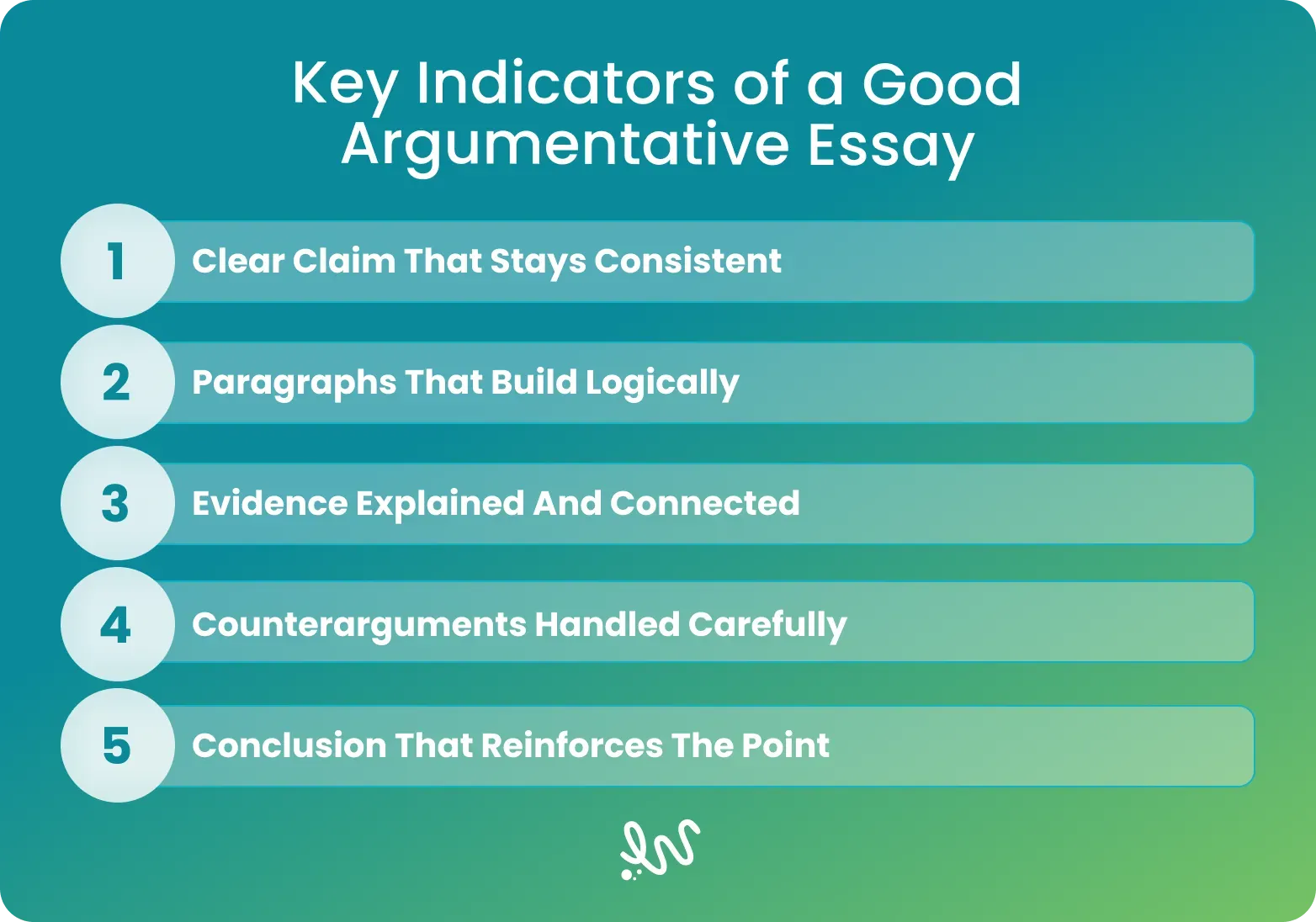
- A focused claim that remains visible throughout the essay
- Paragraphs that build logically instead of repeating ideas
- Evidence that is introduced, explained, and tied back to the claim
- Counterarguments that are acknowledged and answered with care
- A conclusion that reinforces the central position without restating every point
The strongest argumentative essays do one unusual thing well. They make disagreement feel thoughtful. The reader may not change their mind, but they understand why the argument holds. That response signals success.
Final Thoughts
A strong argumentative essay holds together because each part supports the next. The claim stays clear, evidence is explained rather than dropped in, and opposing views are handled with control instead of urgency. When structure guides the argument, persuasion feels steady and credible.
At WriteMyEssay, we see how difficult that balance can be in practice. Students often have solid ideas but struggle to shape them into a focused argument. If you need support beyond examples, you can use our write my essay without AI option to get original writing built from scratch.
Original Essays, Written From Scratch
FAQ
What Is an Argumentative Essay Example?
An argumentative essay example shows how a clear position is presented and defended through reasoning and evidence. It helps readers see how ideas are organized, how claims are supported, and how opposing views are addressed within a structured argument.
How to Start an Argumentative Essay Example?
An argumentative essay example usually begins by introducing the issue and giving enough context for the reader to understand why it matters. The opening leads naturally toward a clear thesis that signals the writer’s position without explaining every detail at once.
How to Write an Argumentative Essay Example?
Writing an argumentative essay example involves developing a focused claim and supporting it with evidence explained in context. Each paragraph builds on the previous one, counterarguments are acknowledged thoughtfully, and the argument progresses in a logical direction.
How to Conclude an Argumentative Essay Example?
An argumentative essay example concludes by reinforcing the main claim and showing why the argument holds. The ending ties ideas together, reflects on their significance, and leaves the reader with a clear sense of the argument’s strength rather than a simple summary.
Sources
- Bay Atlantic University. (2024, November 26). How to write an argumentative essay. Bay Atlantic University. https://bau.edu/blog/how-to-write-an-argumentative-essay/
- Kennesaw State University Writing Center. (n.d.). Argumentative essay. Kennesaw State University. https://campus.kennesaw.edu/current-students/academics/writing-center/open-educational-resources/argument-essay/index.php
- Wilfrid Laurier University. (n.d.). Argumentative essay. Wilfrid Laurier University. https://students.wlu.ca/academics/support-and-advising/student-success/assets/resources/writing/argumentative-essay.html