Key Takeaways
- A claim sentence states a clear position and gives writing direction from the start.
- Compelling claims are specific, arguable, and focused on one central idea.
- Every claim needs supporting evidence and explanation to convince readers.
- Different types serve various purposes in essays.
- Clear claims make arguments easier to follow and support with evidence.
A claim in writing is a clear statement that takes a position on a topic and sets up what the writer plans to argue or explain. It informs readers about the paper's content and indicates the direction the argument will take. While a thesis statement often frames the overall argument, a claim makes the central position explicit and shows what will be argued throughout the paper.
When shaping or refining a claim feels difficult, our graduate essay writing service supports students with clear examples that help strengthen focus, clarity, and academic precision.
WriteMyEssay Supports Real Student Writing

What Is a Claim in Writing?
A claim in writing is a clear, specific statement that presents a position on a topic and guides the argument of a paper by telling readers exactly what the writer intends to prove or explain.
It functions to:
- Establish the main point that the writing will focus on
- Appeal to readers with a clear sense of direction early in the text
- Shape how evidence and examples are selected and used
- Set the boundaries of the argument so the paper stays focused
Elements of a Claim in Writing
A claim includes three elements: explanation, evidence, and application of evidence to the claim. To see how these elements work together, let’s look at a clear example and break it down step by step.
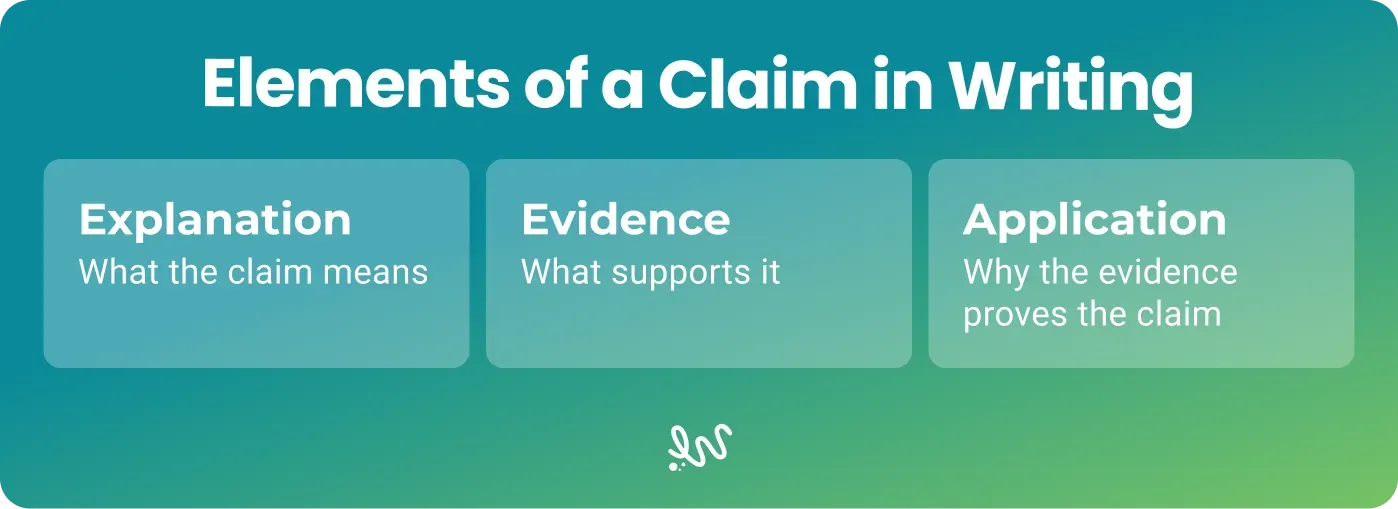
Example claim: Universities should teach students how to understand data before asking them to argue with it.
This claim is about preparation, not theory. Students are asked to analyze studies, cite statistics, and discuss trends long before they’re taught how numbers can mislead or inform.
Example of explanantion: The claim points out a gap between what students are expected to do in class and the learning skills they’re formally taught.
Evidence grounds the claim in reality.
Example of evidence: Many graduates report feeling unsure when reading charts or statistics, and some employers note gaps in basic data interpretation, even among strong candidates.
This step shows why the evidence matters.
Example of application of evidence: If students leave college uncomfortable with data, yet are constantly asked to use it, requiring instruction in data literacy directly addresses that gap.
Which Main Types of Writing Use Claims?
Claims show up whenever a piece of writing tries to say something important. Sometimes they’re obvious, while other times, they sit quietly underneath the words, holding everything together. The type of writing changes how a claim sounds, but not what it does.
- Academic & Research Writing: In essays, research papers, and case studies, a claim keeps the work focused. Claim starters tell the reader what idea is being tested, explained, or challenged.
- Persuasive & Professional Writing: Whether it’s an argumentative essay, a proposal, or a report, the claim spells out what the writer wants the audience to accept or act on.
- Creative & Analytical Writing: Claims still exist, even when the writing feels open or reflective. Literary analysis, such as the interpretation of a novel, a cultural critique, or personal writing, all lean on a central idea about meaning. The claim guides the reader, even if it never announces itself directly.
Types of Claims
Claims don’t all sound the same because they don’t all try to do the same thing. Sometimes, a writer is stating something that can be checked. Other times, they’re defining an idea, judging its worth, or pushing for a change. Once you see the pattern, it gets easier to choose the correct kind of claim instead of forcing everything into one rigid form.
The most common claim types include fact, definition, value, cause, comparison, and policy claims. Below is a quick table that shows how each works in real writing.
Claim Type | Description | Example |
|---|---|---|
Fact | States something that can be verified as true or false through evidence | Remote work has changed how many companies measure productivity. |
Definition | Explains what a term means when the meaning is unclear or debated | Digital literacy goes beyond using technology and includes judging online information. |
Value | Makes a judgment about importance, quality, or worth | Public libraries remain one of the most valuable spaces in local communities. |
Cause | Argues that one event or condition leads to another | Long-term sleep deprivation affects students' focus and memory. |
Comparison | Shows meaningful similarities or differences between options | Hybrid classes offer more flexibility than entirely in-person schedules. |
Policy | Argues that a specific action, rule, or change should be taken | Universities should require introductory financial literacy courses. |
For students under pressure, our authors write nursing essays that meet academic and clinical standards.
How to Make a Claim in Writing?
Good claims are built step by step. You start with a question people could reasonably argue about, decide where you stand, narrow the idea so it actually fits the assignment, and then support it with evidence that you take the time to explain. Most papers break down when one of these steps gets rushed, especially when evidence is dropped in without showing how it connects. The eight steps below walk you through the process of shaping a claim that actually works.
1. Start making a claim with a question that can be argued: If the answer feels obvious or purely factual, you’re heading toward a summary instead of an argument. Choose a question where reasonable people could land on different sides. That disagreement gives your claim meaning and direction.
2. State your position plainly: Write your claim as one direct sentence. Say what you believe about the topic without hedging or avoiding the point. If you can’t explain your claim out loud without adding extra clarification, it’s probably too vague.
3. Narrow the scope: Big ideas sound impressive, but collapse when it’s time to prove them. Tighten the claim by limiting its focus. You might narrow by time, group, location, or situation. A smaller claim is easier to defend and easier for readers to follow.
4. Know what kind of claim you’re making: Not all claims work the same way. Some state facts, while others define ideas, judge value, explain causes, compare options, or argue for action. Identifying the type helps you choose the right kind of support and avoid mismatched evidence.
5. Let evidence shape the claim: Instead of forcing sources to fit your idea, look at the evidence first. If the strongest proof points slightly away from your original wording, revise the claim. A flexible claim statement backed by solid evidence is stronger than a perfect paragraph with weak support.
6. Explain how the evidence proves your point: Facts and statistics alone are not enough. After presenting evidence, explain how it supports the claim and clarify the reasoning behind that connection so readers can follow the logic without assumptions.
7. Test the initial claim against objections: Imagine a reader who disagrees with you. What would they question first? If a single counterexample breaks your claim, revise it. A good claim survives reasonable challenges without falling apart.
8. Place the claim where readers expect it: In most essays, the claim appears early so readers know what they’re being asked to accept. Once it’s stated, move quickly into support. Strong writing doesn’t leave the claim hanging without explanation.
To strengthen structure and argumentation, you can read this guide on academic writing skills for practical strategies.
Claim Examples in Writing
Examples of claims illustrate how an argument goes beyond description and takes a position that requires justification. Instead of listing information, a claim makes a debatable statement, such as 'Universities should require first-year writing courses' (policy), 'Remote work improves employee productivity' (fact), or 'Electric cars are more beneficial than gasoline vehicles' (value). Effective claims stay specific, present a clear stance, and leave room for evidence and explanation.
Claim of Fact Examples
A claim of fact argues that something is true or false based on evidence and can be proven through research or observation. Common claim ideas in this category focus on what is happening or has happened:
- Working remotely has helped many companies keep employees longer.
- Most teenagers need more sleep than early school schedules allow.
- Social media has reshaped how people encounter news and information.
- The pace of climate change has increased over the past few decades.
- Exam periods are the most stressful time of the academic year for many college students.
- Online classes have made higher education accessible to students who were previously excluded.
- Regular physical activity improves focus and mental performance.
- Advertising plays a measurable role in shaping buying decisions.
- Poor air quality contributes to health problems in large cities.
- Early access to education affects academic outcomes later in life.
Claim of Value Examples
A claim of value makes a judgment about importance, quality, or worth and explains why something should be seen as good, bad, beneficial, or harmful:
- Public libraries remain one of the most valuable shared spaces in a community.
- High-stakes testing creates more pressure than learning benefits.
- Remote work offers a healthier balance between personal life and career demands.
- Arts programs deserve the same respect as science and math courses.
- Fast fashion causes more harm than benefit to society.
- A college degree is still a worthwhile investment for many students.
- Team sports help students develop discipline and cooperation.
- Personal data deserves stronger protection online.
- Reading fiction helps people better understand others.
- Community service plays an important role in education.
Claim of Policy Examples
A claim of policy argues that action should be taken and usually proposes a change, rule, or solution:
- Schools should restrict phone use during class time.
- Colleges should teach basic financial skills as a graduation requirement.
- Governments need to invest more heavily in clean energy.
- Employers should give workers more control over their schedules.
- Social media companies should do more to protect user privacy.
- Universities should lower the cost of required textbooks.
- School days should start later for younger students.
- Companies should provide accessible mental health resources.
- Cities should invest more in public transportation.
- High schools should require civic and voting education.
Better Writing Starts With WriteMyEssay
Final Words
Understanding how claims work makes writing clearer and more focused. When a claim statement takes a clear position and matches the right type, the rest of the essay becomes easier to organize and support. Effective claims give readers direction and help arguments stay grounded instead of drifting.
If shaping an argument or refining ideas keeps slowing you down, it makes sense to get support instead of pushing through alone. Students can use ‘do my essay by real writers’ service. WriteMyEssay offers practical help through clear examples, thoughtful feedback, and support with writing that keeps ideas sharp and assignments on track.
FAQ
How Long Is a Claim in Writing?
A claim is usually one sentence. In some cases, it may stretch to two sentences if the idea needs slight clarification, but anything longer risks turning into an explanation instead of a clear position.
What Is the Formula for Writing a Claim?
A simple formula works well: explanation + evidence + application of evidence. You name and explain what you’re writing about, find evidence, and hint at how that evidence is applied to real life so that the claim makes sense. This gives the claim direction without overloading it.
How to Start a Claim in Writing?
Start by stating your position clearly. Avoid background details or broad context at this stage. A claim works best when it gets to the point and lets the rest of the writing do the explaining.
How to Write a Good Claim?
A good claim is specific, arguable, and focused. It avoids obvious facts, stays narrow enough to prove, and invites discussion rather than shutting it down. If someone could reasonably disagree with it, you’re on the right track.
What Is an Example of a Claim in Writing?
An example of a claim in writing is: Universities should require financial literacy courses for all undergraduates. This statement takes a position, suggests change, and leaves room for evidence and debate.
Sources
- New College of Interdisciplinary Arts and Sciences. (n.d.). Guide to writing a claim. Arizona State University. https://newcollege.asu.edu/writing-program/guide/claim
- University of Pittsburgh, Department of Communication. (n.d.). Argument: Claims, reasons, evidence. https://www.comm.pitt.edu/argument-claims-reasons-evidence
- Marteney, J. (n.d.). Types of claims. In Writing arguments in STEM. California State University Pressbooks. https://pressbooks.calstate.edu/writingargumentsinstem/chapter/types-of-claims/